
Fayette County Busted Mugshots
Every busted booking in Fayette County runs through one door. That door is the county jail inside the Fayette County Justice Center. It holds true no matter who made the arrest. La Grange police, Schulenburg, Flatonia, a constable, DPS, a rural deputy. The Sheriff's Office states plainly that it houses everyone arrested in the county. So one office runs one custody system. The facility is small, about 45 beds. For that reason, the Sheriff roster is usually the smartest first check for a fresh local arrest.
Timing matters too. The arrest, the booking, and the moment a name shows up online can each fall on a different day. Release, transfer, bond, and court dates follow their own clocks. The public roster shows only the custody slice of a booking record. It is not a full court file.
Fayette County Booking Record Fields
The county's "Inmates Currently in Custody" search offers a short, practical set of fields. It will not answer every question. A written request can surface different material, and only the Sheriff can confirm what exists for a given booking and what can be released. Watch name matches closely. Common surnames and spelling drift trip people up all the time.
| Field | What the public result can show |
|---|---|
| Inmate name | The name used for the roster search and result. It is not identity proof by itself. |
| Date and time booked | The jail intake event, which may differ from the arrest, filing, or disposition date. |
| Charge or charges | Charges recorded at booking, not convictions or final court findings. |
| Bond amount | A bond figure, not a sentence. Blank or changed values need jail or court confirmation. |
| Booking number and photo | Neither was clearly shown in the reviewed public result view. Ask the records custodian about a specific record. |
| Court date and custody status | Not separately supplied in the reviewed view. The jail and the correct clerk or court are the next sources. |
- Booking
- Jail intake after an arrest or transfer, when identifying and charge information is recorded.
- Bond
- A court-set amount or condition connected to release. It is not a judgment.
- Arraignment or magistrate warning
- An early court process that is separate from the jail roster.
- Disposition
- The court’s later result, such as dismissal, plea, acquittal, or judgment.
Request Fayette County Booking Records
Need a formal answer? Want a record the roster doesn't show? Put it in writing. Texas Public Information Act requests go to the department that actually holds the record. Fayette County's own guidance warns that each department's elected official serves as its public-information administrator. Aim at the wrong office and your request sits in the wrong pile. The Sheriff names Renee Moreland as its Open Records contact. It also supplies an Open Records Request Form to get you started.
- Name the Fayette County Sheriff’s Office as the recipient and identify the person as precisely as possible.
- Give an approximate arrest or booking date and the arresting agency, if known.
- Request the booking record and any booking photograph maintained for that event, preferably in electronic form.
- Ask for any fee estimate, redacted portion, withholding basis, or need for an Attorney General ruling.
- Keep the request, date sent, response, and supporting court documents together for later follow-up.
1646 North Jefferson
La Grange, TX 78945
979-968-5856
Open Records contact: Renee Moreland, through the Sheriff’s request form.
The Sheriff posts no booking-photo fee and no fixed turnaround promise. State public-information rules push agencies to act promptly. A governmental body generally must speak up if it can't produce material within ten working days. That's a general rule, though, not a Sheriff-specific pledge. The County Clerk's fee schedule is a separate matter. It lists $1 per page for copies, including emailed or faxed ones. Certification runs $1 per page plus $5, and a criminal search costs $5. Those are court-record charges. Don't assume they carry over to a Sheriff booking response.
Fayette County Busted Photo Rules
The official roster shows text, not booking photographs. No written Sheriff policy states whether photos are always withheld, released only on request, posted for a set stretch, or kept for a fixed period. So the honest answer is narrow: no image appeared in the public roster view. Ask the Sheriff directly whether a specific photo exists and whether it can be released, rather than betting on guaranteed access or a flat ban.
Texas Government Code Chapter 552 sets the public-information framework, with exceptions carved out for protected material. Section 552.029 covers specified information about inmates in facilities run by, or under contract with, TDCJ. It does not force county jails to post every booking image online. Juvenile, victim-identifying, medical, security-sensitive, sealed, and expunged information can carry separate protections. Fayette County's request guidance likewise notes that some records are excluded.
A missing online image proves nothing about destruction. The photo may sit with its original custodian, await a request and review, or be shielded from release. The right move is a specific, neutral request. An old cached listing or an online omission is never an authoritative word on retention.
Fayette County Jail Busted Lookup
Start with the Sheriff's Inmates Currently in Custody search if the person may still be held locally. It's built for just-booked and county-custody situations. Expect some lag around releases and transfers. It won't tell you about state prison, federal custody, immigration holds, or active warrants.
| Roster search field | Use |
|---|---|
| Inmate name | Use a full or partial name when accepted by the form. |
| Charge(s) | Add a charge only when it helps distinguish people with similar names. |
| Date Booked From | Sets the start of a targeted booking-date window. |
| Date Booked To | Sets the end of the window, including a same-day search when it matches the start date. |
- Open the official roster and search the name first.
- Add a charge or booking-date window only when it will narrow the result.
- Read the name, booked date, booked time, charges, and bond as a custody lead.
- Call the Sheriff to verify a current hold, release, transfer, or unexpected result.
- Use a written request for a record or image not displayed by the roster.
The roster states no posting interval, no removal schedule after release, no photo-retention period, and no archive window. Older or odd-looking dates may catch your eye. Don't read a rule into them. When something looks off, verify it with the Sheriff rather than guessing how long a record stays online.
Fayette County Recent Busted Bookings
There's no separate same-day, 48-hour, weekly, or archived Sheriff booking feed under a special brand. The roster's Date Booked From and Date Booked To fields are the only official route to a recent window. Want today's bookings? Enter the same date in both fields. For a wider stretch, spread the range apart. Keep in mind it's a filter, not a guarantee that every booking lands on a set schedule.
Results display name, booking date and time, charges, and bond. A photograph did not appear in the public view. La Grange and Schulenburg offer no shared live arrest log. Flatonia's council packets do carry a monthly police-report category for arrests and pending charges, but that retrospective city material isn't a county booking feed. And when a name is missing, the cause could be release, transfer, another custodian, your date selection, or simple publication lag.
Fayette County Booking Snapshots
The Fayette County Record offers a paper-trail view of local bookings. Its June 2023 issue counted 66 people booked during May. Eight were taken on to TDCJ. An earlier February 2022 issue reported 38 booked in January. Five were transported. Those numbers are handy markers of sheriff activity in a given month. They are not a running annual tally. And they are not a name-by-name roster you can check for custody today.
For a small county with a single jail, snapshots like these set useful context. They just can't answer the live question. Is a named person in a cell right now? For that, the current Sheriff roster and a direct call to the jail are the paths that count.
Fayette County Arrest History
Want the long view instead? The Texas DPS ten-year arrest-report compilation breaks down submissions from the Fayette County Sheriff, the La Grange Police Department, constables, and other agencies, with adult and juvenile categories running through 2019. It is history, not a live count. Treat it as background on the agency mix rather than a substitute for the jail roster.
Dates also tell different stories across offices. A city police report carries one date, a county booking another, and a court file may show a later filing or disposition date. Checking one system proves nothing about what the others hold. Each record answers its own question, so pull from the office that keeps it.
Fayette County Booking Alerts
Don't expect a Sheriff booking app here. No mobile inmate-lookup application appears in the county's official navigation, corrections materials, or roster path, and the roster itself runs in a browser. A general city app is not a booking tool. Nor was any official social account confirmed as a steady source of booking photos or a live arrest list.
Warn Central Texas handles regional emergency alerts, not recent bookings. Texas IVSS is a separate statewide channel for custody and court notifications, open to eligible participants through its own portal. Neither one posts booking photos. Stick with the roster for current custody, the Sheriff for record questions, and these alert tools for their actual purpose.
Fayette County Busted Custody Paths
A name missing from the county roster can mean many things. Release is one. A transfer is another. A hold by some other agency counts too. So match your source to the custody question you're asking. Official channels come first. Each one answers a narrower question than a general web search ever could.
| Channel | Custody or record slice | Photo and access finding |
|---|---|---|
| Fayette Sheriff roster | Just booked or in county custody | Official web search. No public booking photo displayed in the reviewed view. |
| Sheriff records request | County booking record held by the Sheriff | Official written-request path. Ask whether a particular photo exists and is releasable. |
| TDCJ offender search | Sentenced and received into Texas state custody | Official locator accepts name or TDCJ identifiers. TDCJ says public photographs will not be provided. |
| Federal BOP locator | Federal custody from 1982 forward | Official federal status tool, not a Fayette booking-photo source. |
| ICE detainee locator | Immigration detention or recent transfer | Official immigration custody tool, not a local arrest-photo substitute. |
| County Clerk, District Clerk, or JP | Case, magistrate, or disposition stage | Official court path. The District Clerk has no public online record set and offers an in-office computer. |
State prison works differently. The Texas Department of Criminal Justice locator covers people transferred into state custody, not ordinary pretrial holds in the local jail. You can search by name. A prior TDCJ number works too. So does a full or partial current number. BOP and ICE run on entirely separate systems. A hit in one locator does not rule the others in or out.
For county custody, go local. The Fayette County Corrections page names the Justice Center setting used for that purpose.
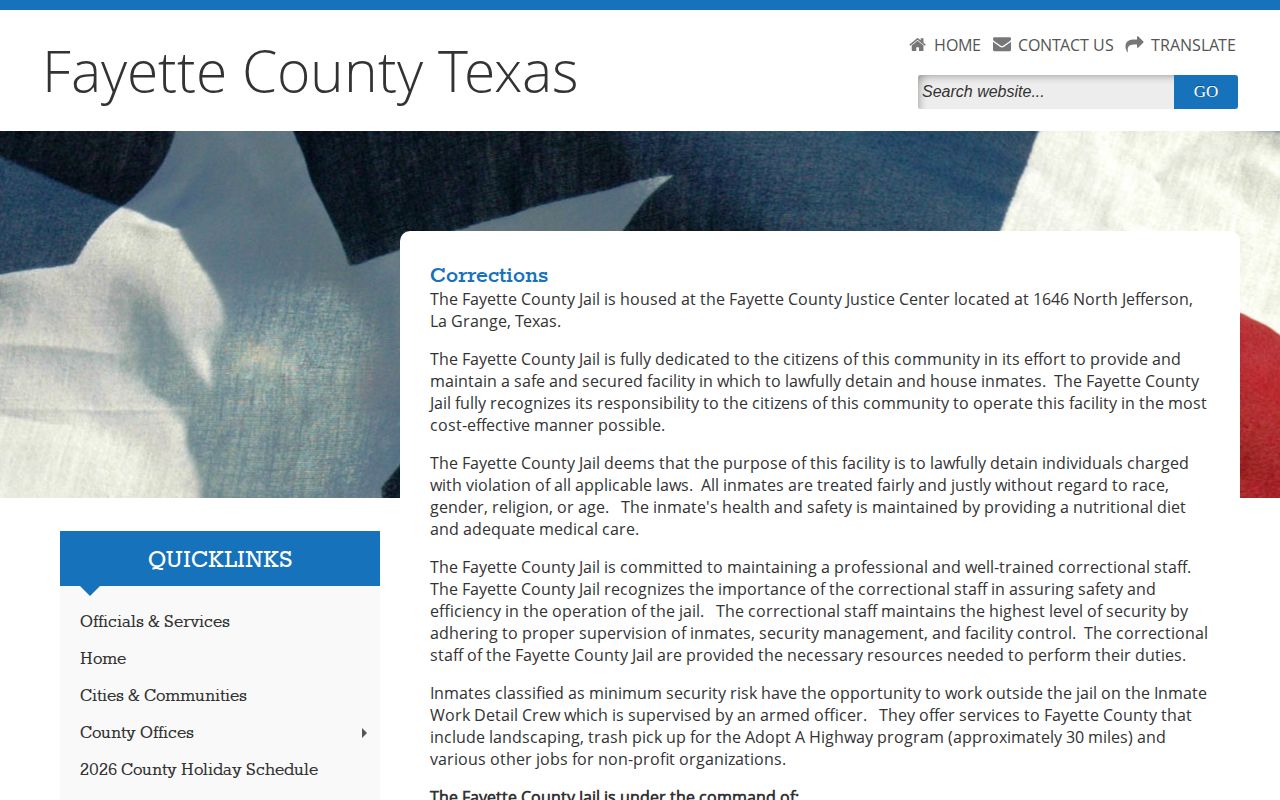
Put simply, facility details serve the local-custody route. A later TDCJ, BOP, or ICE result describes a different stage of custody altogether.
Fayette County Court Record Trail
A booking record is just the first stop. The courthouse splits what comes next. Justice of the Peace courts take Class C criminal matters and magistrate functions. The County Clerk keeps misdemeanor criminal cases. The District Clerk holds felony files for the 155th Judicial District and reports that its public records are not online, though an in-office public computer serves open cases. That division of labor means a court outcome can take more digging than a roster entry.
Go to the County Clerk for misdemeanors and the District Clerk for felonies. A roster result never shows a case outcome. And the dates are not interchangeable: event or arrest date, booking date, filing date, and disposition date can each differ. A dismissal, deferred adjudication, acquittal, plea, probation, or judgment carries its own legal meaning. Read the court file as the later record rather than inferring it from the initial charge.
Fayette County Busted Record Corrections
Fixing a wrong entry starts with the law that governs data brokers. Texas Business & Commerce Code Chapter 109 lays out when covered businesses must verify, correct, or remove criminal-record information. The chapter has real limits, though. It grants no blanket right to deletion. It does not turn a news outlet into a records office either. To challenge a county item, contact the agency that created it and bring precise, reliable documentation. If a court later changed the outcome, get the clerk record showing that result first.
Some cases qualify for a true wipe. Texas Code of Criminal Procedure Chapter 55A sets out the expunction path. Reported waiting periods are 180 days for a qualifying Class C misdemeanor, one year for Class A or B, and three years for a felony. Eligibility rules and exceptions still apply throughout. Waiting alone is not enough. You have to prove eligibility too. Expunction and nondisclosure are two different tools. The first aims to remove qualifying records entirely. The second seals them from ordinary public view but keeps lawful access intact.
Confirm any official change with the agency or court first. The third-party page Mugshots.com's record-maintenance policy spells out a free, documentation-based process for qualifying removals and disposition updates. Be careful with the big aggregator brands. No Fayette County, Texas local section was confirmed for RecentlyBooked, Busted Newspaper, Arrests.org, or Mugshots.zone. Treat their generic state pages and national policies as something other than local coverage. Skip paid fixers whenever a documented free route exists.
Fayette County Booking Retention
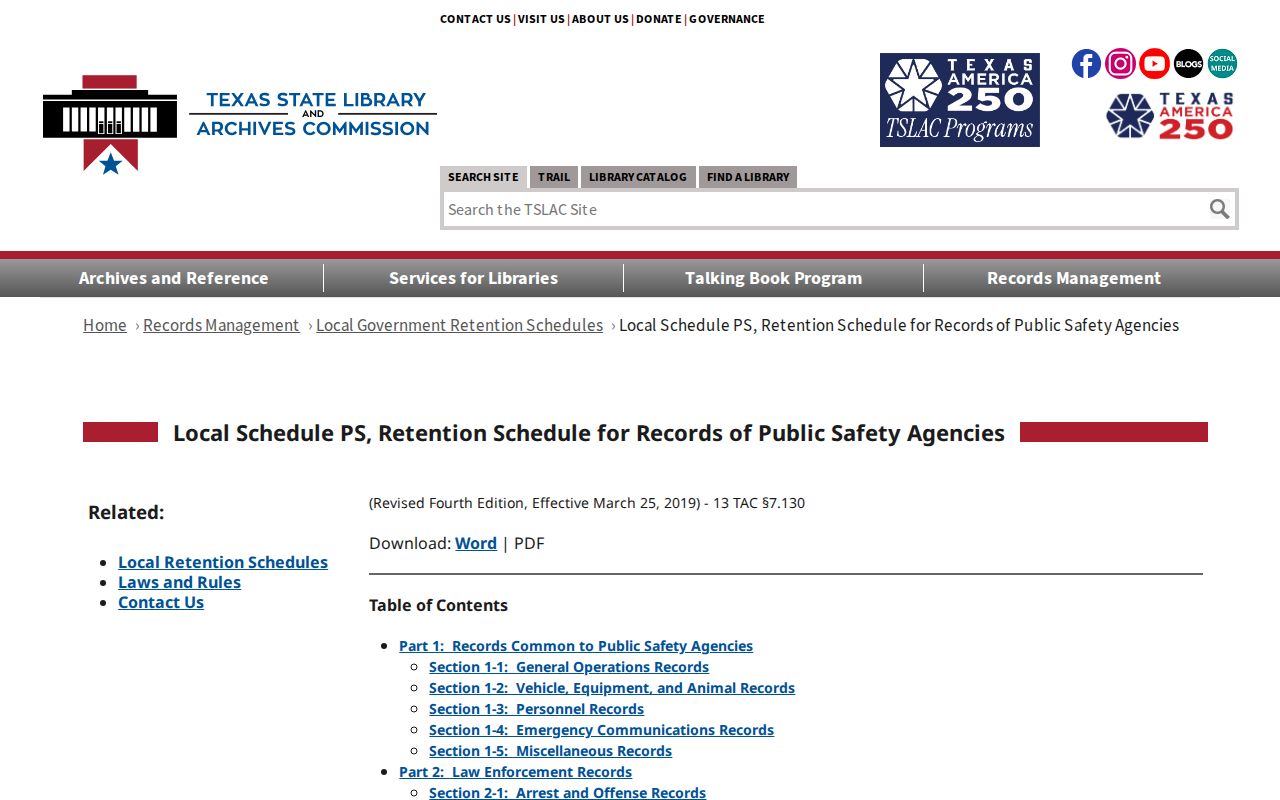
Retention schedules tell you what a county may keep, not what it actually holds. Texas State Library Local Schedule PS is the framework. Its law-enforcement series cover arrest reports along with mugshot and other photographs, and the retention periods track offense level and record series. One series lists six months for Class C matters. Class A or B misdemeanors and state-jail felonies run two years. Second- and third-degree felonies run ten years, and first-degree and capital felonies run fifty. Other series and local adoption choices matter just as much.
For an older Fayette booking record, the practical questions are concrete. Does the Sheriff still hold it? Which locally adopted schedule applies, when did the clock start, and was the material transferred or lawfully destroyed? Someone released from custody can vanish from the current roster. The underlying booking report may live on in a file anyway. A state-prison record falls under TDCJ rules instead. Federal or immigration records sit in their own systems. The county pages here publish no automatic roster-purge timetable, no photo-retention rule, and no transfer register.
The state's Local Schedule PS explains the statewide framework.
Old newspapers are a different hunt. The Fayette County Area Newspaper Collection can surface vintage sheriff and police reporting, but it cannot confirm that a particular booking photo survived, was digitized, or stays publicly available today.
Fayette County Busted City Links
One arrest can leave paperwork in two places. City police keep their own reports. The Sheriff's office handles county custody. A single event may appear in both systems. La Grange, the county seat, is the largest city on the map. Schulenburg and Flatonia run their own municipal police and records routes too. For county custody questions, though, the Sheriff stays the core source unless another agency or facility currently holds the person.
- La Grange Busted Mugshots covers the city police path, City Secretary records route, and the county-jail connection.
- Schulenburg Busted Mugshots covers the police department, open-records route, and the county custody check.
- Flatonia Busted Mugshots covers the police department, City Secretary route, and its monthly council-packet reporting context.
A city report proves an arrest, not a cell. Check the roster for current county custody, and ask the record custodian for the underlying report.
Fayette County Busted News Checks
Start with official channels, always. Try the Sheriff, the courts, or a state locator that fits your question first. After that, the Fayette County Record offers narrative monthly reporting that adds context the rosters lack. Treat it as journalism rather than a live booking feed. No routine local photo gallery was confirmed. For deeper history, the Portal to Texas History's Fayette County Area Newspaper Collection holds reporting from the Record, Schulenburg Sticker, Flatonia Argus, and La Grange Journal. It is built for the past, not for present custody.
Only two Fayette-specific third-party leads checked out. Those are the Mugshots.com Fayette County section and JailExchange's Fayette County Jail page. Neither is official. Neither's update timing, completeness, or sourcing is established here. Both can run stale. Use them as pointers only, never as substitutes for the Sheriff roster, a records request, or a court file.