
Fayette County Wanted Fugitives and Warrant Search
Begin with the Fayette County Sheriff's Current Active Warrants search. The Sheriff's wording is careful. The tool lists people who may have active warrants held by county law-enforcement agencies. Nothing more. There is no published count. No update schedule, weekly photo feature, or mugshot feed exists. A name on the list is the start of a question, not the answer to one.
A warrant result and a jail roster answer two different questions. A name on the warrant page does not mean that person sits in the Fayette County Jail or the Justice Center right now. For custody, use the official inmate search described in the county-wide Fayette County records and roster guide. Someone released, transferred, or never booked locally may not show up there either.
The Sheriff's warrant-search page is the source for the search screen shown below.
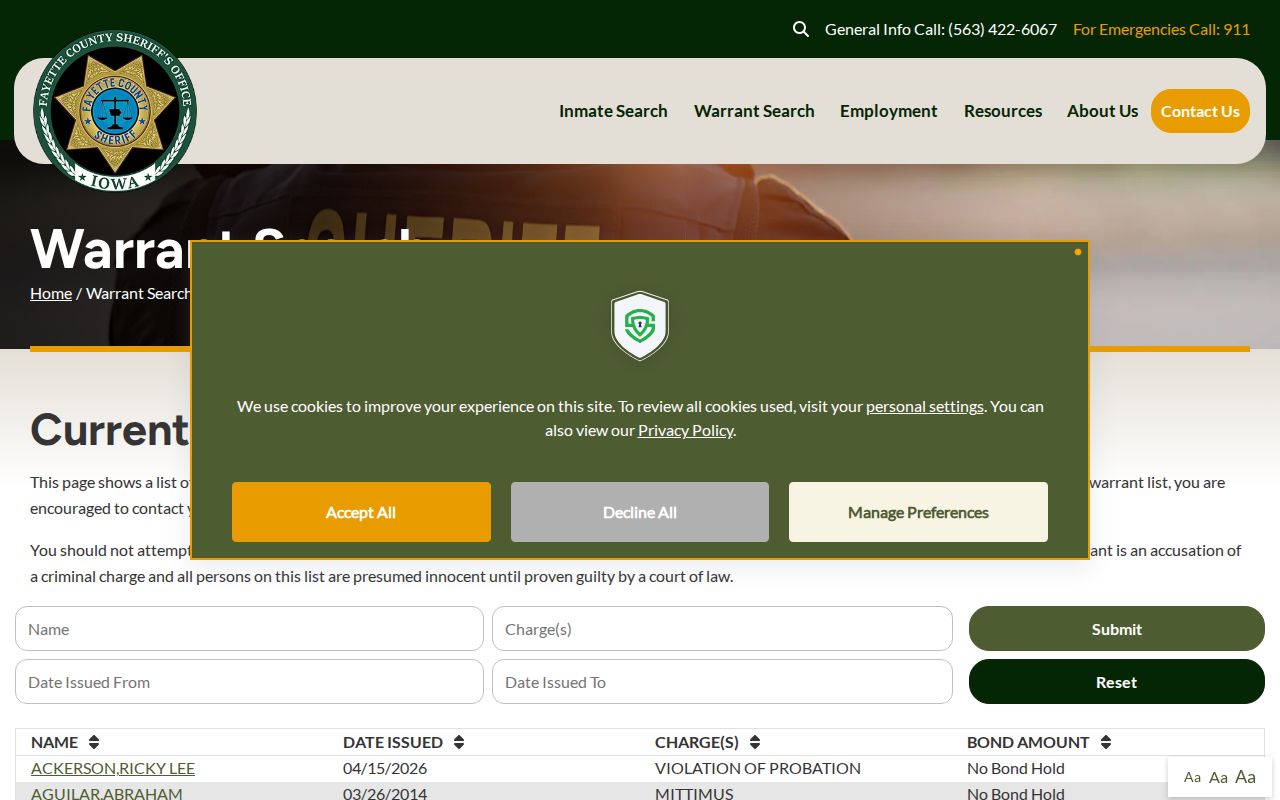
What you'll find is a plain text search. There is no photo-based wanted feed here, so verifying current status falls to the agency itself.
Fayette County Warrant Search Fields
Think of the search fields as filters, not proof. A common last name can pull up several different people, and the public output is not a court-certified record. The tool lets you search by name, by charge, and by an issued-date range using from and to boxes. Results come back as a compact entry. Before you rely on any of it, check the details with the Sheriff or the court that issued the warrant.
| Field | What the official search shows |
|---|---|
| Name | A person’s name used to locate a possible warrant result. |
| Charge(s) | A charge filter and a result field, reflecting the charge associated with the listing. |
| Date issued from | A start-date filter for narrowing a warrant search. |
| Date issued to | An end-date filter for narrowing a warrant search. |
| Date issued | The issue date shown in a result, which is not the same as an arrest, booking, or disposition date. |
| Bond | A bond amount displayed with the result. It does not establish guilt or resolve the current warrant status. |
Note: The Sheriff's page says people "may have active warrants," so a recalled or served warrant can only be ruled out through current confirmation with the agency.
How to Read Fayette County Warrant Results
Common names call for a narrow search. Enter just enough detail to separate one record from another. No more. Keep the warrant's issue date distinct from any later custody or court dates. They measure different things. One more limit is worth knowing: the county publishes no schedule for adding, changing, or dropping entries. What the list shows today may not match tomorrow. A careful reader confirms with the agency rather than trusting the page as a live docket.
- Open the Sheriff’s official Current Active Warrants search and enter a name. Add charge wording or an issued-date range only when it helps distinguish similar results.
- Read the name, date issued, charge or charges, and bond amount exactly as shown. Treat each as a possible warrant lead rather than a final legal determination.
- For current status, call the Fayette County Sheriff’s Office at 979-968-5856 or contact the issuing court. The Sheriff is at 1646 North Jefferson, La Grange, TX 78945.
- If the practical question is custody after an arrest, check the Sheriff’s current-custody roster rather than inferring detention from a warrant entry.
Fayette County Warrant Check and Custody Status
The most direct warrant check runs through the Sheriff's search, then a call to the Sheriff or the issuing court. Fayette County has no separate online Clerk portal for warrants. The Justice of the Peace courts handle Class C criminal matters and magistrate work. The county names them as issuers of relevant felony and traffic warrants. That matters. The warrant page never replaces the issuing court's own record.
Constable precincts help serve warrants, but their contact pages are not a warrant database. The County Clerk's later criminal files differ from a current warrant check too. Start with the Sheriff's search. Then ask the Sheriff or the issuing court which agency controls the status. That habit keeps a search result, service activity, a court case, and current jail custody from blurring into one record they are not.
- Search the official warrant page by name and, if needed, the listed charge or issue-date filters.
- Use the Sheriff’s current contact information, not an unrelated footer number on an older-looking page template, to ask whether a result still needs action.
- Ask which court issued the warrant and what court process applies. A person affected by a warrant can contact that court or an attorney for advice about the appropriate next step.
- Check the inmate roster separately if the question is whether a person is now in county custody. A warrant can predate a booking, and a booking may occur under a different timeline.
One practical caution: the warrant page has carried a stale footer contact that does not match current details. That mismatch tells you nothing about whether a warrant exists. It does tell you to use the current Fayette County Sheriff contact page and the Sheriff's 979-968-5856 line instead.
Fayette County Warrant Types and Court Roles
The public results show charges and bond amounts. They do not lay out a full taxonomy of warrant types. The table below lists only the local court roles the county itself documents. Do not use it to label any individual record beyond what the official search and the issuing court actually say.
| Documented warrant path | Local role | Confirmation route |
|---|---|---|
| Class C criminal matters | Justice of the Peace courts handle these criminal matters and magistrate functions. | Ask the issuing Justice of the Peace court or the Sheriff about a specific result. |
| Traffic warrants | The county identifies Justice of the Peace courts as issuing relevant traffic warrants. | Confirm the court, status, and appearance procedure with the issuing court. |
| Felony warrants | The county identifies Justice of the Peace courts as issuing relevant felony warrants; later felony records are handled through the District Clerk. | Use the Sheriff and issuing court to confirm the warrant. The District Clerk’s case access is separate from the warrant search. |
| Sheriff search result | The public result shows name, issue date, charge(s), and bond, with a “possibly active” qualification. | Confirm before acting, because the public display is not a real-time certification. |
Fayette County Crime Stoppers Tips and Safety
Fayette County Crime Stoppers is the official route for anonymous tips. The county says the program dates back to 1981. It pairs the Sheriff's Office with three municipal police agencies. Tipsters never have to give a name. Information that might help law enforcement belongs there. It does not belong in personal digging or a public confrontation with anyone.
Fayette County Crime Stoppers
Anonymous tip line: 979-968-8477
A good tip can pay. Rewards run up to $2,500 for information that leads to a felony arrest and grand-jury indictment, and added language covers some Class A and B misdemeanor cases. The final amount always depends on program rules and approval. See the county's Crime Stoppers information for those details.
A tip is not a mission to hunt anyone down. Never go find or confront a person yourself. In an emergency, call emergency services right away. Someone who believes a warrant names them should go through the issuing court or an attorney instead. Social media and third-party listing sites will not resolve it.
Public Record Search
Sponsored Results